
Gas fireplaces
Gas fireplace pilot lights, then goes out — what that actually means
A pilot that lights while you hold the knob down and goes out the moment you release it means the flame sensor is no longer convincing the gas valve that there is a flame — usually a dirty or weak pilot, sometimes a failed thermocouple, and occasionally a venting fault that is putting the pilot out on purpose.
$69 inspection — credited back in full when you book the repair
What you are seeing
- The pilot lights, burns steadily while you hold the knob, and dies within seconds of letting go
- It stays lit but the main burner will not come on when you flip the switch or press the remote
- It held fine last winter and started dropping out on the first cold weekend of the season
- The pilot flame looks lazy, yellow or floppy rather than a tight blue cone
- It relights and runs for an hour or two, then goes out again on its own
The knob is not a switch — it is a safety test
Holding the pilot knob down is you manually overriding a safety device. A standing-pilot gas fireplace has no mains power behind the valve; instead a small sensor sitting in the pilot flame generates its own tiny current, and that current is the only thing holding the pilot gas valve open. Let go of the knob and the valve asks the sensor a simple question: is there still a flame? If the answer is not a clear yes, it shuts the gas off.
So a pilot that dies on release is not the fireplace being temperamental. It is a safety interlock working exactly as designed, on a system that can no longer prove a flame is present. That distinction matters, because the fix is never to make the interlock stop asking.
Which sensor is failing decides which symptom you get. A thermocouple holds the pilot itself alive, so when it weakens the pilot will not stay lit at all. A thermopile is a larger version that generates enough power to open the main burner valve, so when it weakens the pilot stays on happily and the fireplace simply refuses to light when you hit the switch. The same family of fault, two completely different complaints.
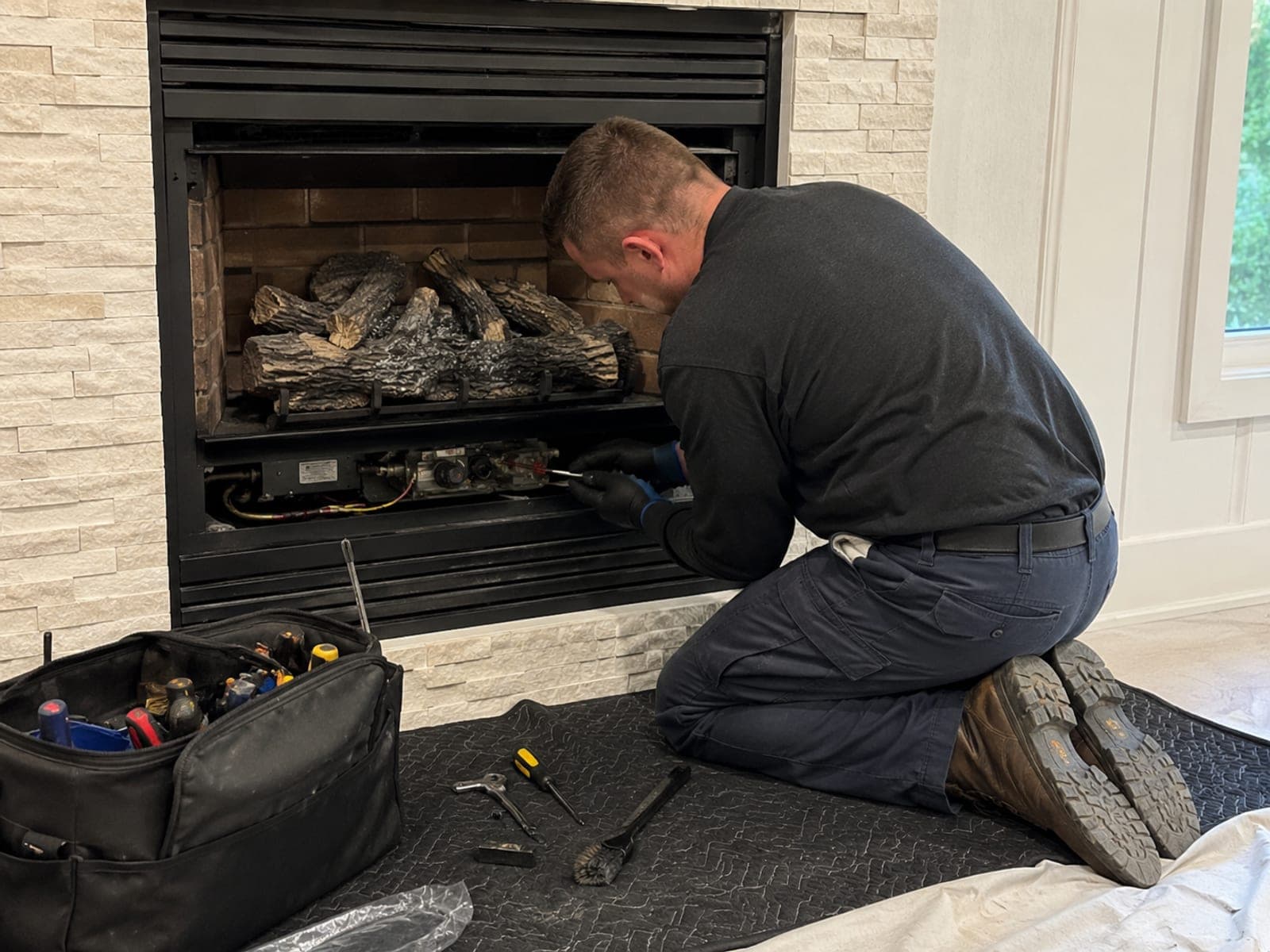
Every photo on this site is our own work. We do not use stock photography.
Why this lands in October, and why it lands all at once
A gas fireplace in Kansas City sits unused from roughly April to October. Six months of stillness in a warm cavity is an invitation, and the pilot orifice is a very small hole. Spiders and mud daubers are drawn to the odorant added to natural gas, and a nest in that orifice starves the pilot into a lazy yellow flame that no longer wraps around the sensor tip. The sensor cools, the current falls, the valve closes.
The gas has not changed and neither has the valve. What has changed is that the flame is no longer touching the part of the sensor it needs to touch. This is the single most common reason a fireplace that worked perfectly in March will not stay lit in October.
The second reason is simply age. A great many Johnson County houses went up between the late 1980s and the late 1990s with a factory-built gas unit as standard, and those original millivolt valves and sensors are now past thirty years old. They do not fail suddenly; they fade. A sensor that produced a comfortable margin when new drifts down until it is only just holding the valve open, and then one cold night it is not.
On the Missouri side the picture is different again. Much of what we see there is a gas log set dropped into an older masonry fireplace, where the pilot is exposed to whatever the flue is doing. A tall exterior masonry chimney that has sat all summer holds a column of cold air, and until that reverses the draught runs the wrong way — down. That will blow a pilot out, and it will do it intermittently, which is what makes it maddening to diagnose from the sofa.
The version of this that is not a worn part
Most pilot outages are a dirty pilot or a tired sensor, and they are a routine service call. A minority are the appliance telling you something you genuinely want to know.
Vent-free units carry an oxygen depletion sensor whose entire job is to shut the pilot down when oxygen in the room drops. If one of those is dropping out repeatedly, the correct reading is not that the sensor has become annoying — it is that the sensor may be doing precisely what it was fitted to do. That is a finding, not a nuisance.
On a vented appliance a blocked or failed flue can put the pilot out as well, because combustion products that cannot leave will come back down around the burner. The point worth holding on to is that all three of these present identically from the homeowner’s side of the glass. You cannot tell them apart by watching the flame, and one of the three is a carbon monoxide question.
That is also why we will not publish a procedure for cleaning a pilot assembly or swapping a sensor. Someone whose real fault is a blocked vent, following instructions written for a dirty orifice, ends up with a fireplace that lights beautifully and vents into the room.
What a technician is actually checking
So that you know what a proper visit looks like, rather than a parts swap:
- The pilot flame shape, and where it sits relative to the sensor tip — the diagnosis usually starts here and often ends here.
- Millivolt output from the thermocouple and thermopile, measured under load rather than at rest, because a sensor can read fine unloaded and collapse the moment the valve draws on it.
- Gas pressure at the appliance, incoming and at the manifold. A regulator or supply fault imitates a sensor fault closely.
- Continuity and connections back at the valve, including the wall switch and remote receiver — a common culprit, and a far cheaper one than the valve itself.
- The vent or chimney, including the cap and termination, on anything that is not a vent-free unit.
- Spillage at the appliance while it runs: whether combustion products are actually leaving the building.
What this looks like
Our own work, around the metro
Every photo on this site is our own work. We do not use stock photography.
Why this one needs a technician
Every link in this chain sits between a live gas supply and the room you are sitting in. Separating a weak sensor from a pressure fault needs a manometer and a millivolt meter, and the two causes that are not a worn part — an oxygen-depletion shutdown and a venting failure — look identical from the outside. Those are the two you cannot afford to guess at, because carbon monoxide has no smell.
Questions we get asked
Is it safe to keep relighting it?
Relighting once to see what happens is reasonable. Repeatedly forcing a pilot that will not hold is not, because you are overriding a safety device without knowing which of three faults tripped it — and one of them is a venting failure.
It is staying lit again now. Has the problem gone?
Usually not. A sensor that has drifted low will hold on a mild evening and fail on a cold one, and a partly blocked pilot orifice behaves the same way. Intermittent is the normal early stage of this fault, not a sign it has resolved itself.
Can I just buy a thermocouple and fit it?
They are cheap and sold everywhere, which is exactly why this fault gets misdiagnosed so often. If the real problem is a dirty pilot, a gas pressure fault or a blocked vent, a new sensor changes nothing — and on the last of those it hides something that matters.
Does a gas fireplace need servicing if it looks clean?
Yes, and clean is not the measure. NFPA 211 calls for an annual inspection whether the appliance burns wood or gas, and gas is the one people skip because there is no soot making the case for it. What is being checked is venting, pressure and flame quality, and none of that shows on the glass.
What does the visit cost?
The diagnostic inspection is $69, and it comes off the invoice in full if you book the repair from it. If the answer turns out to be that nothing needs doing, you keep the written report.
Book the $69 inspection
Tell us what it is doing and we will come and look. Credited back in full when you book the repair — or call (816) 573-3499 and we will take the details on the phone.
The service this points to
Gas Fireplace Repair
Gas fireplace repair covers the ignition and gas train — pilot assemblies, thermocouples and thermopiles, ignition modules, gas valves, blowers and door glass — on direct-vent, B-vent and vent-free units.
Gas Inspection
A gas fireplace inspection verifies that the appliance is burning correctly and venting completely — gas pressure, burner flame pattern, vent integrity and a carbon monoxide spillage test — documented in writing.
Inspection
A chimney inspection is a documented condition assessment of the flue, liner, firebox, crown, cap and flashing, delivered as a written report with photographs rather than a verbal opinion.