
Gas fireplaces
Gas fireplace will not light from the switch or wall control
A gas fireplace with a healthy pilot that does nothing when you flip the switch has a break somewhere in a low-voltage circuit that the fireplace powers itself — most often a weak thermopile, a failed switch, remote receiver or wire in the chase, and sometimes a gas valve or a safety lockout that is refusing on purpose.
$69 inspection — credited back in full when you book the repair
What you are seeing
- The pilot is lit and looks fine, but flipping the wall switch does nothing at all
- It lights from the remote but not the wall switch, or from the wall switch but not the remote
- You hear a faint click at the fireplace when you flip the switch, and then nothing
- It fires on the second or third try, or only after the pilot has been burning for a while
- On a newer unit there is no standing pilot at all — it clicks and sparks for a few seconds, gives up, and will not try again
- It worked in March and ignored the switch on the first cold evening of the season
The switch is not wired to your house
The first thing worth knowing is that on most Kansas City gas fireplaces the wall switch has nothing to do with mains electricity. Kill the power to the whole house and a standing-pilot fireplace still lights, because the pilot flame is the power station. A thermopile sitting in that flame generates roughly half a volt, and that half a volt is the entire electrical supply for the appliance.
The switch, then, is just a gap in a two-wire loop carrying that half-volt back to the gas valve. Close the gap, the valve sees the current, the main burner opens. That is the whole system. It is why a fireplace ignoring its switch is rarely a dramatic fault, and why the parts that fail are usually the cheap ones rather than the expensive one.
It also explains the most common version of this complaint, which is the mirror image of a pilot that will not stay lit. A thermopile that has faded with age still produces enough current to hold the small pilot valve open, so the pilot burns away looking perfectly healthy — but no longer enough to pull in the much heavier main valve when you ask it to. The pilot is fine. The evidence is fine. The fireplace still will not light.
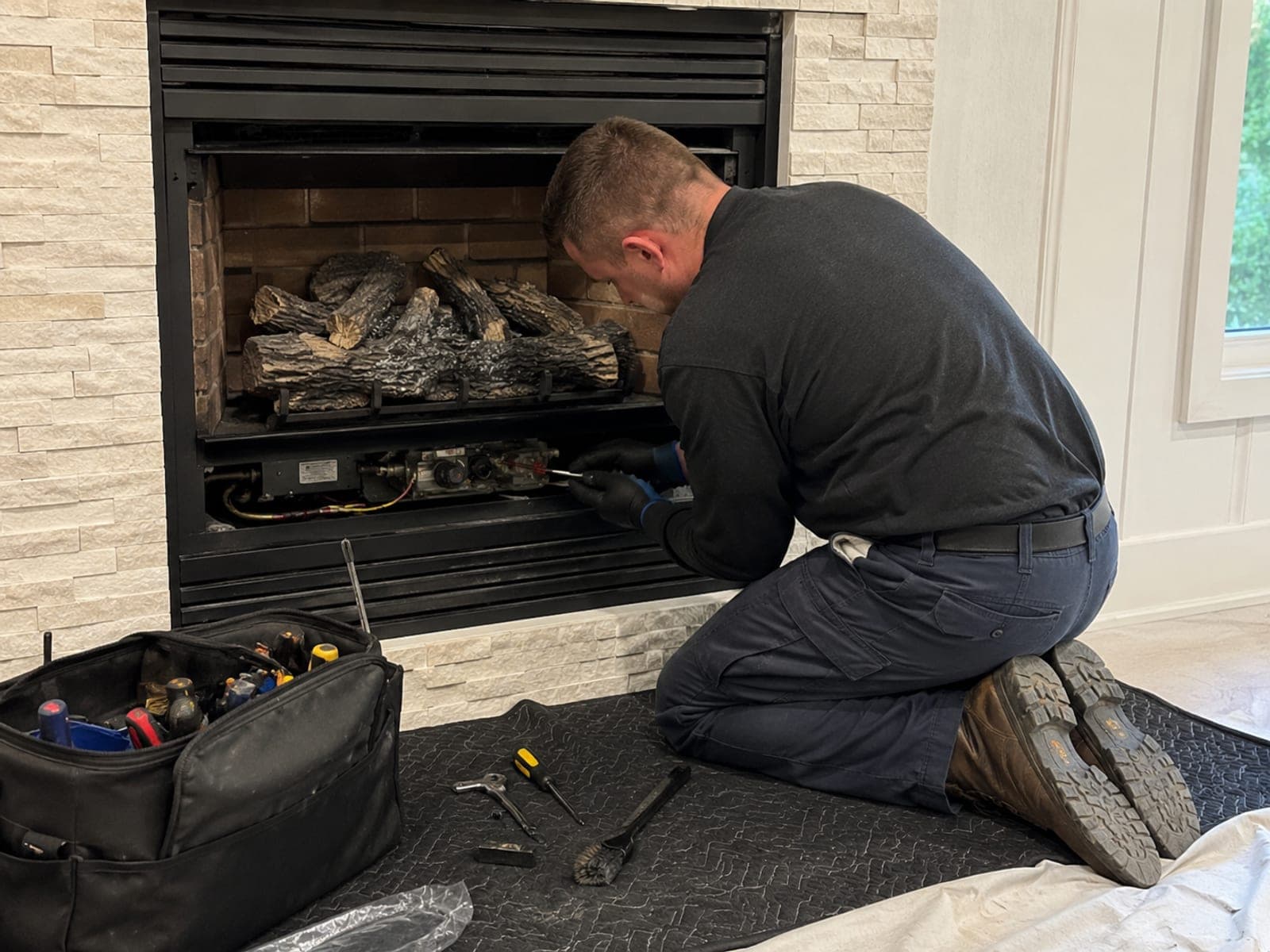
Every photo on this site is our own work. We do not use stock photography.
Which ignition you have decides which fault list applies
There are two quite different appliances behind this same symptom, and in this metro they sort roughly by the decade the house went up.
A great many Johnson County houses built between the mid-1980s and the late 1990s came with a factory-built gas fireplace as standard equipment, and those are almost all standing-pilot millivolt units — a pilot that burns year-round, a thermopile, and the self-powered loop described above. Overland Park’s median build year is 1989, so this is the single most common gas fireplace in the south metro, and every one of them is now past its third decade. Thermopiles do not fail on a date; they fade, and the main valve is the first thing to notice.
Newer units, and replacements fitted from roughly 2010 onward, tend to use intermittent pilot ignition instead. There is no standing pilot: the module sparks a pilot on demand, proves it, and then opens the burner. Those have a control module and a power supply — usually a mains adapter with a battery pack behind it for outages — so on those a dead fireplace really can be a dead battery, and a fireplace that sparks, fails and then refuses to retry is not broken but locked out, which is a different conversation entirely.
On the Missouri side there is a third pattern. A large share of what we see there is a gas log set retrofitted into an older masonry fireplace, often decades after the house was built, with the switch run wherever it was convenient at the time. That wiring was not installed by the appliance manufacturer, it is frequently stapled through a joist bay or run to a switch box shared with a light circuit, and it is the part of that installation most likely to have been disturbed since.
Why it works on the remote but not the switch
Homeowners often assume this narrows things down to the switch. Usually it narrows things down more than that, and in a useful direction.
When both a wall switch and a remote are fitted, the receiver is wired in the same low-voltage loop, and each control is simply another way to close it. So a fireplace that answers one and ignores the other has told you something: the valve works, the thermopile is producing enough current to pull the main valve in, and the fault is on the control side. That is the good outcome — the cheap end of the appliance.
The reverse case is worth reading carefully too. A fireplace that lights from the wall switch but has stopped answering the remote is very often a receiver whose batteries have gone, and that is a genuinely small thing. But on a marginal thermopile the same fireplace will answer whichever control puts the least resistance in the loop and refuse the other, which looks identical from the sofa and is not the same repair at all. The distinction is a meter reading, not an opinion.
The wiring itself is the other candidate, and it is more common in prefabs than people expect. The two conductors from the switch run down inside a wood-framed chase, sometimes stapled tight, and both heat cycling and rodents get at them. A corroded connection at the valve terminals behaves exactly like a failed switch, because in this circuit half a volt has very little to spare.
The version of this that is not a switch
Most of these calls end at a thermopile, a switch, a receiver or a wire. A minority do not, and those are the reason this page stops where it does.
The gas valve can fail, and the operator coil inside it can go open circuit or lose the strength to pull in — which presents as a fireplace that ignores every control while the pilot burns on happily. Gas supply is the other one: a regulator fault, or a line that lost pressure when something else in the house was worked on, will let a pilot burn but not sustain a main burner. Both imitate a control fault well enough that guessing costs you a valve you did not need.
On an intermittent-pilot unit, a lockout after several failed ignition attempts is not a malfunction to be reset until it takes. The module tried to prove a pilot, could not, and stopped trying — and the reasons it could not include a blocked pilot orifice, low gas pressure and a venting problem. Repeatedly cycling the power to clear a lockout is the electronic equivalent of holding the pilot knob down: it overrides the part of the appliance that was doing its job.
This is where we stop, deliberately. We will not publish a procedure for jumping the switch terminals at the valve, which is the shortcut every forum offers, because it is a live test on a gas control and it produces a confident answer that is wrong whenever the real fault is supply pressure or venting. From your side of the glass a fireplace that will not light looks the same in all of these cases.
What a technician is actually checking
So you know what a proper diagnostic visit looks like, in roughly the order it happens:
- Thermopile output measured twice — open circuit, then again under load with the valve pulling on it. A tired thermopile reads respectably at rest and collapses the moment it is asked to do work, which is exactly the fault that produces a healthy pilot and a dead switch.
- The pilot flame itself: shape, colour, and how much of the thermopile tip it is actually wrapping. Most weak-output readings are a flame problem rather than a dead sensor.
- Continuity through the switch, the receiver and the run of wire between them, and the condition of the terminals at the valve, where corrosion does most of its damage.
- Gas pressure at the appliance, incoming and at the manifold, because a supply fault and a control fault present identically.
- On intermittent-pilot units, the fault or lockout history stored in the module, plus the power supply and battery backup.
- The vent, cap and termination, and a spillage check while the appliance runs — on any unit that is not vent-free, this is the check that matters most and the one that gets skipped.
What this looks like
Our own work, around the metro
Every photo on this site is our own work. We do not use stock photography.
Why this one needs a technician
The whole circuit runs on about half a volt, so the difference between a failing thermopile, a corroded terminal and a valve that will no longer pull in is a millivolt reading under load — not something you can see or hear. Two of the causes on the list are gas pressure and venting, and both let the pilot burn convincingly while the appliance refuses to light. Those are the ones worth paying someone to rule out, because carbon monoxide has no smell.
Questions we get asked
The pilot is burning fine. Does that not rule out the gas side?
No — it only proves there is gas at the pilot. The main burner needs far more flow and a much stronger pull on the valve than the pilot does, so a supply pressure fault or a fading thermopile will leave a perfectly healthy-looking pilot and a fireplace that will not light.
Is it just the batteries in the remote?
Sometimes, and it is the first thing we check. But a marginal thermopile also answers one control and refuses the other, so a fireplace that responds to the wall switch and ignores the remote is worth confirming with a meter rather than assuming.
Can I jump the two switch wires at the valve to test it?
That test is all over the internet and we will not publish it, because it is performed on a live gas control and it returns a clean result even when the real fault is low supply pressure or a blocked vent — which are the two you most need to find.
My newer fireplace sparks, then stops trying. Is it broken?
Probably not broken — it has locked out, which is the ignition module refusing to keep releasing gas after it failed to prove a pilot. The lockout is a message, and the things behind it include a blocked pilot, low pressure and a venting fault, so clearing it repeatedly is the wrong response.
What does the visit cost?
The diagnostic inspection is $69, and it comes off the invoice in full if you book the repair from it. If it turns out to be something small, you will hear that, and you keep the written report either way.
Book the $69 inspection
Tell us what it is doing and we will come and look. Credited back in full when you book the repair — or call (816) 573-3499 and we will take the details on the phone.
The service this points to
Gas Fireplace Repair
Gas fireplace repair covers the ignition and gas train — pilot assemblies, thermocouples and thermopiles, ignition modules, gas valves, blowers and door glass — on direct-vent, B-vent and vent-free units.
Gas Inspection
A gas fireplace inspection verifies that the appliance is burning correctly and venting completely — gas pressure, burner flame pattern, vent integrity and a carbon monoxide spillage test — documented in writing.
Inspection
A chimney inspection is a documented condition assessment of the flue, liner, firebox, crown, cap and flashing, delivered as a written report with photographs rather than a verbal opinion.